How Long Should a YouTube Description Be?
The limit is 5,000 characters, which is not the useful number. The number that matters is about 150 — the amount a viewer sees before pressing "Show more". Almost every mistake people make with descriptions is a consequence of optimizing for the wrong one of those two figures.
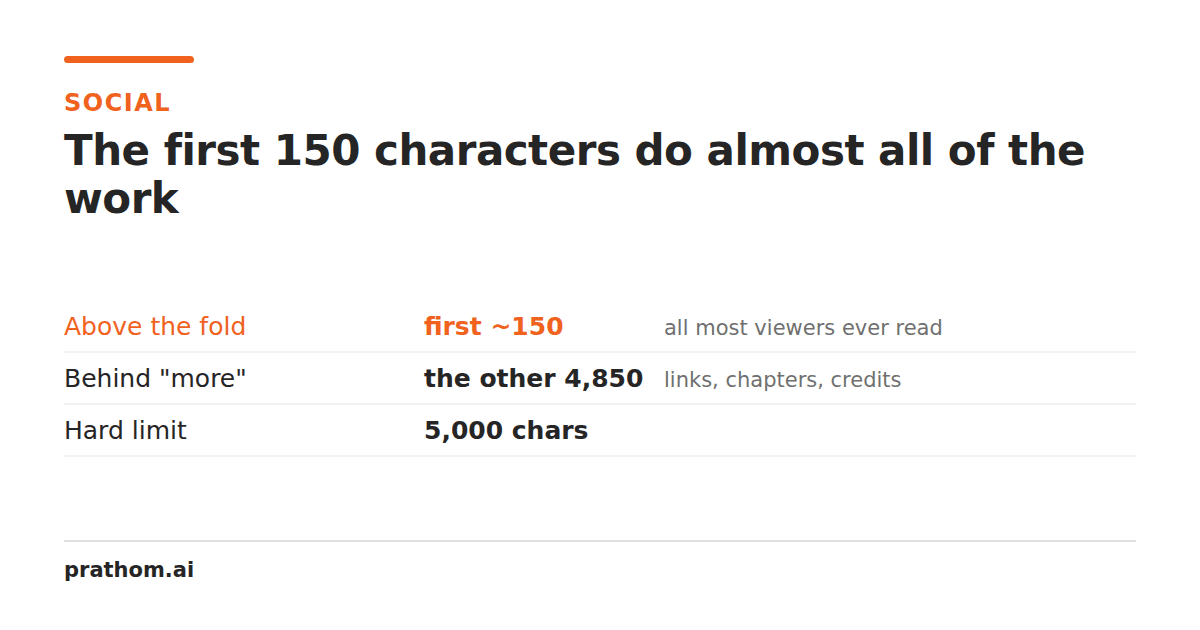
There are two numbers, and confusing them is the whole problem.
5,000 characters is the hard limit YouTube enforces. About 150 characters is what a viewer actually sees before the description collapses behind "Show more". The second number is where the work goes.
What happens in the first 150 characters
That region does three jobs at once:
- It is the only part most viewers read, because most viewers never expand.
- It is where search snippets are usually drawn from, so it is what appears under your video in results.
- It is doing the heavy lifting for YouTube's own understanding of the video, because it is the part most consistently written about the actual content.
The exact cutoff moves with screen width and which surface you are on — mobile app, desktop, embedded player. Anywhere from about 100 to 160 characters. Plan for 150 and you will be right often enough; plan for 300 and you will be wrong on phones, which is where most viewing happens.
The practical consequence: everything ceremonial has to go below the fold. Greetings, your channel name, "don't forget to like and subscribe", your socials. Each of those is a character not spent telling someone whether this video answers their question.
What the remaining 4,850 characters are for
They are not wasted, but they work differently. Below the fold belongs:
- Chapters. A timestamp list starting at 0:00 with at least three entries turns into a chapter bar on the progress track. This is the single highest-value thing below the fold, because it changes the player's behavior rather than just adding text.
- Links. Resources, gear, your other videos. Put a short description in front of each rather than a bare URL, because a bare URL tells the reader nothing.
- Context. A few sentences of genuine detail — what version of the software, what the constraints were, what you would do differently.
- Hashtags. Three is the useful number, because only the first three appear above the video title.
One hard rule worth memorizing, because it fails silently: adding more than 15 hashtags to a video causes YouTube to ignore all of them, not just the excess. An over-tagged video is strictly worse off than an untagged one.
Length by video type
| Video type | Total description | Why |
|---|---|---|
| Short entertainment clip | 150-400 chars | Nothing below the fold to say; padding it adds nothing |
| Tutorial or how-to | 800-2,000 chars | Chapters earn their place, and so do links |
| Long-form or documentary | 1,500-3,000 chars | Context and sources are genuinely useful |
| Podcast episode | 2,000-4,000 chars | Guest bios, topics, and timestamps all belong |
There is no length bonus. A 3,000-character description of a two-minute clip does not rank better than a 200-character one; it just contains 2,800 characters of filler that a viewer has to scroll past.
The mistake that keyword advice causes
The most common self-inflicted damage is repeating the target phrase five or six times in slightly different forms. It reads badly to a human, which is the part people notice, and it does not do what they think for the algorithm either.
Write the subject naturally once or twice. What actually moves the needle is indirect: a description that accurately sets expectations brings you viewers who stay, and watch time is a far stronger signal than any placement of a keyword. The vague, over-optimized description keeps everyone clicking and keeps everyone bouncing, and the second half of that sentence is the one that matters.
How to check the fold before you publish
The awkward part is that you cannot see the fold in YouTube's editor — you have to publish and look. The YouTube description generatorshows a live preview of the first 150 characters as one flat line, which is what the platform effectively shows, and it assembles the chapter block from the points you list so the labels are not retyped.
If you would rather work in a document, paste the draft into the word counterand read the character count. Then read the first sentence on its own and ask whether those words alone would make you watch. If the answer is no, shorten the opening rather than adding to it — a weak opening does not get stronger with a second sentence in front of it.
The short version
Write the first 150 characters as if they are the whole description, because for most viewers they are. Put chapters, links and context below. Use three hashtags and never more than fifteen. Ignore the 5,000-character limit entirely; you will never be near it, and being near it would not help.