How Many Hashtags Should You Use?
Two of the four numbers people quote are rules the platforms enforce and two are just conventions, and nobody ever says which is which. One of the real rules fails in a way you would never notice: exceed YouTube's limit and it discards every hashtag on the video, not just the extras.
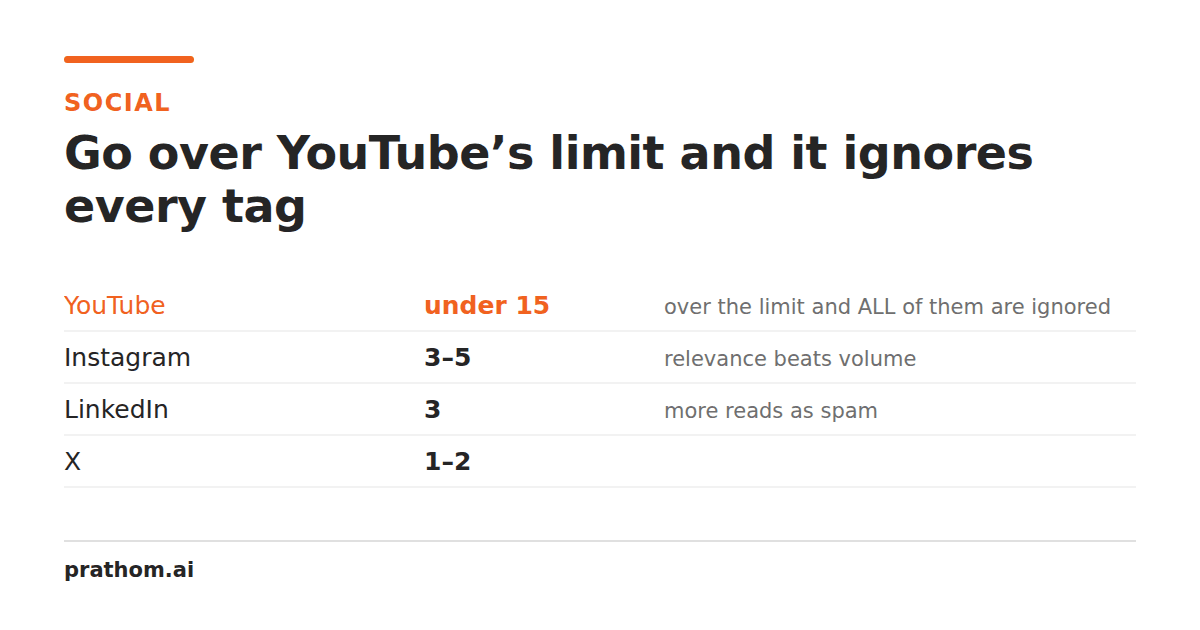
Here are the numbers, with the important column being the last one.
| Platform | Number | Enforced by the platform? |
|---|---|---|
| up to 30 | Yes — anything beyond is ignored | |
| YouTube | up to 15 | Yes, and see below |
| TikTok | 3-6 | No published limit |
| X / Twitter | 1-2 | No published limit |
The YouTube rule that fails silently
Adding more than 15 hashtags to a YouTube video causes YouTube to ignore all of them. Not the excess — all of them.
This is the only one of these numbers where overshooting actively costs you something you would otherwise have had. Nothing warns you. The tags still appear in your description as text. They simply stop functioning, and an over-tagged video ends up worse off than an untagged one.
Only the first three appear above the video title, so the practical target on YouTube is three to five, with fifteen as a ceiling you should never approach.
Why Instagram's 30 is not a target
Instagram allows 30 and a great deal of advice reads that as an instruction. It is a ceiling, not a goal, and hitting it is usually a symptom of not having decided which tags matter.
The reason is that tags are not interchangeable, which is the single most under-explained thing about them:
#photographyhas hundreds of millions of posts. A post from a small account appears in it for a few seconds and then is thousands of posts deep. Being in it achieves categorization, not reach.#keralalandscapeshas few enough posts that something decent can sit visibly in it for days.
Thirty tags all of the first kind is a set that reaches nobody while feeling extremely productive — which is exactly why it is the most common mistake.
The mix that actually matters
Think in tiers rather than in counts.
Broad — single common words. Include two or three. Their job is telling the platform what category you are in, not getting you seen.
Mid — two-word compounds and established community tags: #landscapephotography,
#sourdoughclub, #photographydaily. This is where a good post from a small
account has a genuine chance, and where most of your set belongs.
Niche — specific compounds, usually place-qualified or qualifier-qualified. Small audiences, real chance of leading them. If your subject has a location, place-qualified tags are almost always your best available option, because local intent is far less contested than a generic topic.
A reasonable split is about 20% broad, 50% mid, 30% niche. On Instagram with 20 tags that is roughly 4 / 10 / 6.
Tags that do nothing
Intent words. #besttips, #howto, #bestideas. Nobody browses these. They
describe how you are presenting something rather than what it is about.
Tags on the modifier instead of the subject. For a video about cold brew coffee,
#coldloversis meaningless and #coffeeloversis not. This one is easy to do
accidentally when generating tags from a phrase.
Invented communities. #photographydailyis a real community with real people
in it. #photographyquicklyis not, and no rule tells you which is which — only
knowing does.
Banned or limited tags. These exist, the lists are not published, and they change. If a post gets unusually little reach, one restricted tag is a plausible cause and worth eliminating.
Should you put them in the caption or the first comment?
For Instagram this argument has run for years and the honest answer is that no public evidence separates the two on reach. The real difference is readability: tags in a first comment keep the caption clean.
Pick whichever you prefer and stop spending thought on it. The tier mix is worth thinking about; the placement is not.
Working out a set
Our hashtag generatorbuilds a set from your own words, groups every suggestion into the three tiers above with a line explaining what each tier is for, and weights the result toward mid and niche rather than broad. It also labels which platform numbers are enforced rules and which are our recommendation, and tells you which of your words it dropped as filler — so a thin result has a visible cause.
What it deliberately does not do is show you post counts. There is no free source for that data, and a number invented to look authoritative is worse than no number, because you would act on it. What can be reasoned about without data is that a two-word compound is necessarily narrower than either word alone — and that is enough to get the mix right.
The short version
YouTube: three to five, never more than fifteen, because fifteen-plus discards everything. Instagram: fifteen to twenty-five, weighted away from the obvious ones. TikTok: three to six. X: one or two. And on every platform, the tier mix matters more than the count.