Why Two Word Count Tools Give You Different Numbers
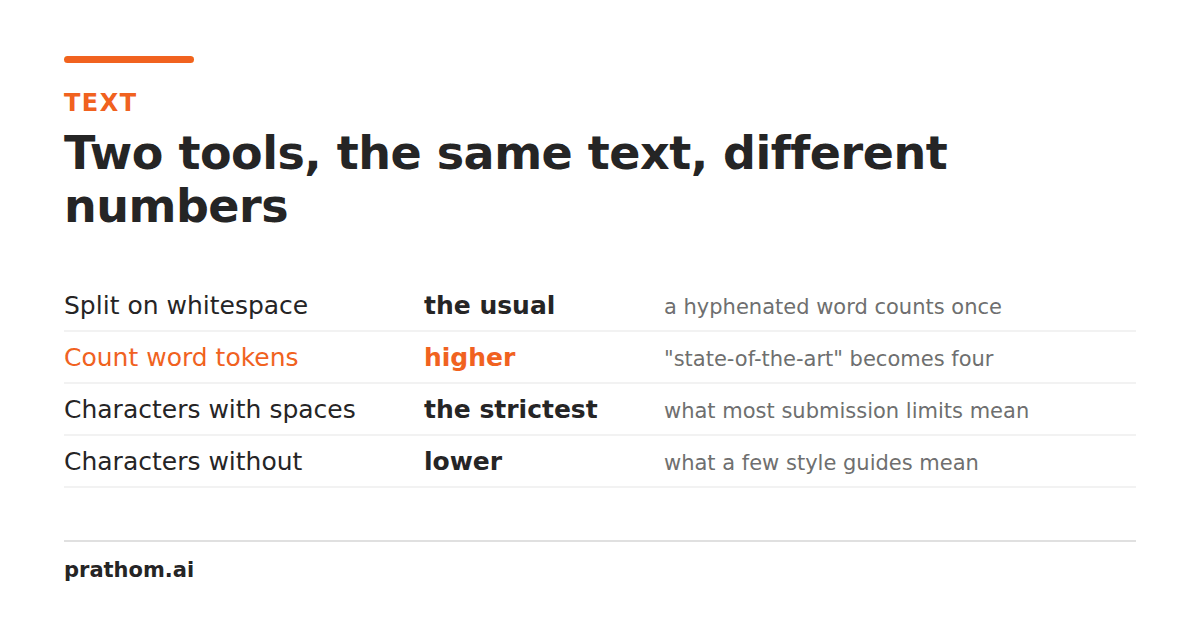
Word count sounds like an objective measurement. Paste the same paragraph into Word, Google Docs, and a browser tool and you can get three different numbers. None of them is broken — they disagree about what a word is, and hyphens, numbers, and em dashes are where the disagreement lives.
Take this sentence: The state-of-the-art system cost $1,250 — twice the estimate.
Depending on which tool you ask, that is 8, 9, 10, or 12 words. Every one of those answers follows a defensible rule.
Where the disagreement comes from
Hyphenated compounds. Is state-of-the-artone word or four? Microsoft Word says
one, splitting only on whitespace. Some online tools split on any non-letter and say
four. A publisher's house style might say four for a manuscript word count while their
CMS says one.
Numbers with punctuation. $1,250— one word, or does the comma split it into
1and 250? A whitespace-based counter says one. A counter splitting on
non-alphanumerics says two, and reports a number where you wrote a price.
Em dashes. estimate—twicewith no surrounding spaces is one whitespace-delimited
token and two words to a reader. This is common in edited prose and it is where the
"one word" difference usually hides.
Contractions and possessives. don'tand John'sare single words by every
sensible rule, but a counter splitting on apostrophes turns them into two — and then
reports donand tas separate words in a frequency list, which is where you notice.
URLs and emails. [email protected]is one token. A counter splitting on
punctuation makes it three, and if there is a long URL in your text the count can be
out by a lot.
Which rule is right?
For a word count, splitting on whitespace runs is the most defensible, because it matches what a reader would count and it is what Word does — which matters, since Word is what most word limits were written against.
For a word frequency analysis, the answer differs. Here you want don'tkept whole
but state-of-the-artprobably split, because you are looking for meaningful terms
rather than tokens. Our word frequency counterkeeps
apostrophes and hyphens inside words for exactly this reason: don'tand well-known
are terms, and splitting them produces a frequency table full of tand s.
Our word countersplits on whitespace, so its number matches Word closely enough for any limit expressed in words.
Which number does your limit mean?
This is the practical question, and the answer is usually knowable.
A university word limit almost always means Word's count, because that is what the department checks it in. If a 2,000-word essay comes in at 2,050 by your tool and 1,990 by Word, you are fine.
A journal or publisher limit often has a definition in the submission guidelines, including whether footnotes, captions, and references count. Read it — the definitional difference between "with references" and "without" is far larger than any tokenisation disagreement.
A CMS or form limit is frequently in characters rather than words even when the
label says words, and if it is enforced in JavaScript it is probably counting
string.length, which is UTF-16 code units. For text with emoji that is a genuinely
different number, not a rounding difference. The
character counterreports all three definitions side by
side.
An ad platform or social limit is enforced by their code, so their counter is correct by definition. Use theirs.
Reading and speaking time are estimates, not counts
Most word counters also report reading time, and it is worth knowing these are derived figures with wide error bars.
Reading speed for adults on ordinary prose is around 200-250 words per minute, and tools generally use something in that range. Technical material is slower. Reading on a phone is slower than on paper.
Speaking is much slower — about 130 words per minute for prepared speech, against the 150 figure many tools use, which is closer to a reading-aloud pace than a presenting pace. If you are planning a talk, the arithmetic for speech lengthis worth reading, because the difference compounds: at five minutes it is about a hundred words you will not have time to say.
Sentence and paragraph counts are worse
If word counting is ambiguous, sentence counting is genuinely hard.
Splitting on ., !and ?breaks immediately on Dr. Sharma, e.g., 3.14, and
etc.. Every implementation has a list of exceptions, and every list is incomplete. A
count that is out by a few sentences on a long document is normal.
Paragraph counting is easier but still convention-dependent: does a blank line separate paragraphs, or does any newline? A tool counting every newline as a paragraph break reports a poem as thirty paragraphs.
Treat both as indicators. Word count is reliable within a percent or two; sentence count is a rough guide.
The short version
Word counters disagree about hyphens, numbers, and dashes, and the spread on ordinary prose is one or two percent. That is well inside any sane limit. If you are close enough to a limit for the difference to matter, count it in whatever tool the person enforcing the limit will use.