YouTube Title Length: Where Titles Actually Get Cut
The character limit is 100 and almost nobody hits it. The number that decides whether your title works is the point where each surface truncates, and those range from about 40 characters on a mobile home feed up to around 70 on desktop search. Which means the real skill is word order, not brevity.
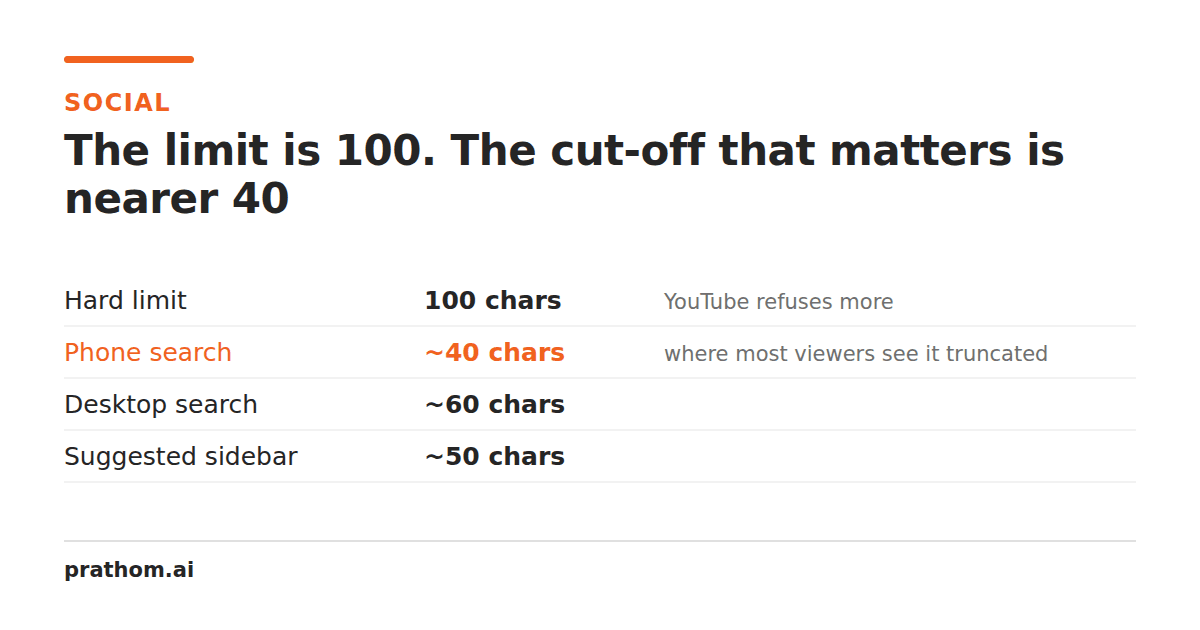
100 characters is the hard limit. You will not reach it, and reaching it would not help. What matters is where each surface stops showing your title, because that differs and the shortest one wins.
Roughly where each surface truncates
These move with viewport width and YouTube's own layout changes, so treat them as planning figures rather than constants:
| Surface | Approximate cut-off |
|---|---|
| Mobile home feed card | 40-50 characters |
| Mobile search results | 50-60 |
| Desktop search results | 60-70 |
| Desktop sidebar suggestions | 40-50 |
| Watch page (under the player) | full title |
The only place your whole title is guaranteed to appear is the watch page — which is the one surface where the viewer has already decided to click. Everywhere that matters for the click, something is being cut.
The consequence is word order, not length
Because truncation always happens at the end, a title's meaning has to be complete early. This is a different instruction from "keep it short", and it is the one that actually helps.
Two titles of identical length:
The Three Mistakes Everyone Makes When Brewing Cold Brew Coffee— at 45 characters this reads "The Three Mistakes Everyone Makes When Brewing…", which could be about anything.Cold Brew Coffee: The Three Mistakes Everyone Makes— cut at the same point it reads "Cold Brew Coffee: The Three Mistakes…", which is already enough to decide.
Same information, same length, and the second one survives the cut. Front-loading the subject is the whole technique.
Aim for 45-65
Below about 40 characters you are usually leaving out something useful — a constraint, a number, a qualifier that would make the promise concrete. Above about 65 you are writing text that most impressions will not show.
45 to 65 is wide enough to say something specific and narrow enough to survive most surfaces. Go past it deliberately, not accidentally: a long title is occasionally the right call, and knowing that you have made that choice is the difference.
What goes in the space you have
Specificity over intensity. A concrete number, constraint or outcome beats an adjective every time. "Sourdough in a 40-minute workday" tells a viewer what they get; "The ultimate sourdough guide" tells them only how the author feels about it.
One idea. A title trying to cover two things spends its budget on the conjunction and delivers neither.
Curiosity you actually satisfy. Withholding the answer earns a click. Misrepresenting the content earns a click and then a bounce, and bounces are what suppress a video. The distinction is not a moral one; it is which of them survives contact with the analytics.
Casing: pick one and be consistent
Title Case and sentence case both work, and the evidence does not favor either. What clearly does not work is mixing them inside one title — "How to make cold brew Without Guesswork" looks like a bug, and readers register it as carelessness even if they could not say why.
ALL CAPS words are worth a mention: one, occasionally, for a genuine emphasis is fine. A title that is mostly capitals reads as shouting and is heavily associated with low-quality content, which is a signal you are giving away for free.
Emoji
They render in titles and they do draw the eye in a crowded feed. Two things to know. First, they consume characters from your budget — some consume more than one, because an emoji can be several code points glued together. Second, they are inconsistently rendered across platforms and clients, so a title that depends on one for its meaning breaks somewhere.
Use one at most, at the start or the end, and never as a word.
Checking a title
Count characters as you write. Our character counterreports grapheme clusters, code points and UTF-16 units separately, which matters more than it sounds for anything containing an emoji — the three numbers can differ substantially, and the one a platform enforces is not always the one you would guess.
If you want options rather than a count, the YouTube title generatorproduces ten per topic, marks any that cross the truncation threshold, and adapts its phrasing to whether you described your video as an action or as a subject.
The short version
The limit is 100 and irrelevant. Write 45 to 65 characters. Put the subject first, because whatever else happens, the end is what gets cut.